❤️ A Special Moment: Rowan Atkinson Holds a Newborn as Lily Sastry Watches Through Tears in an Imagined Evening of Tenderness
The music softened before anyone understood why.
Across the small auditorium, conversations faded as Rowan Atkinson stepped into a pool of warm light, holding a newborn wrapped in a cream-colored blanket. He moved carefully, watching the tiny face resting against his arm rather than the audience waiting before him.
Several rows away, his daughter Lily Sastry sat motionless.
In this imagined scene, the evening had been arranged as an intimate celebration of family and new beginnings. The baby belonged to fictional family friends who had invited Rowan to participate in a brief welcome ceremony. It was a simple gesture, planned without any expectation that it would become the emotional center of the gathering.
Yet when Rowan looked up and found Lily in the audience, something changed.
She smiled first. Then her expression softened, and she lowered her eyes.
The moment lasted only seconds, but the room seemed willing to wait.
For anyone expecting a comic entrance, there was an immediate surprise. Rowan offered no exaggerated expression, no carefully timed interruption, and no attempt to turn the baby’s smallest movement into a performance.
Instead, he adjusted the blanket near the infant’s shoulder.
The gesture was so ordinary that it became quietly absorbing. Here was someone accustomed to being watched, giving his full attention to a person too young to know anything about fame.
The newborn stirred, opening one small hand.
Rowan stopped moving.
A few guests smiled as he glanced toward the baby’s parents, apparently seeking reassurance. The mother nodded from beside the stage. Only then did he relax his shoulders and take another step toward the chair waiting beneath the lights.
The imagined ceremony had none of the scale of a major entertainment event. There were no enormous screens or elaborate announcements. White flowers stood beside the musicians, and small lamps cast a gentle glow across the front of the hall.
Guests had been asked to keep their phones away during the welcome.
That request gave the evening an unusual stillness. Nobody needed to decide whether to watch through a screen or search for a better angle. They could simply notice what was happening.
From her seat, Lily watched her father settle into the chair.
He looked down again, checking the position of the baby’s head. Then, with the cautious concentration of someone handling something precious, he shifted his arm slightly.
The infant settled.
A small, relieved smile crossed his face.
That was when Lily reached for a tissue.
Within this fictional account, her reaction comes from the familiarity of the gesture. She recognizes the patient attention, the concern hidden behind a composed expression, and the almost invisible relief when everything seems comfortable.
The audience sees a famous performer holding a child.
Lily sees her father.
There is an intimacy in that difference. People who know someone through their work encounter selected moments: a scene, a photograph, an interview, an appearance. Family members recognize the quieter expressions that pass between those moments.
As the music continued, Lily leaned forward slightly.
Her tears were gentle. She wiped them away, smiled at someone seated beside her, and returned her attention to the stage.
Nobody called attention to her reaction.
That discretion allowed the emotion to remain her own.
Near the chair stood a microphone, but Rowan initially seemed content to let the musicians finish. The baby’s breathing remained soft and steady. Somewhere toward the back of the hall, a chair creaked, and its occupant immediately became still.
When the final note faded, the host approached.
“There’s no hurry,” she said in the imagined exchange.
Rowan glanced at the sleeping infant.
“I suspect,” he replied quietly, “that I’m not the person setting the schedule.”
Laughter moved through the audience.
It was a brief release, affectionate rather than disruptive. Even Lily laughed, pressing the tissue beneath one eye.
Then Rowan looked toward the baby’s parents and thanked them for trusting him with this part of the evening.
His remarks were short.
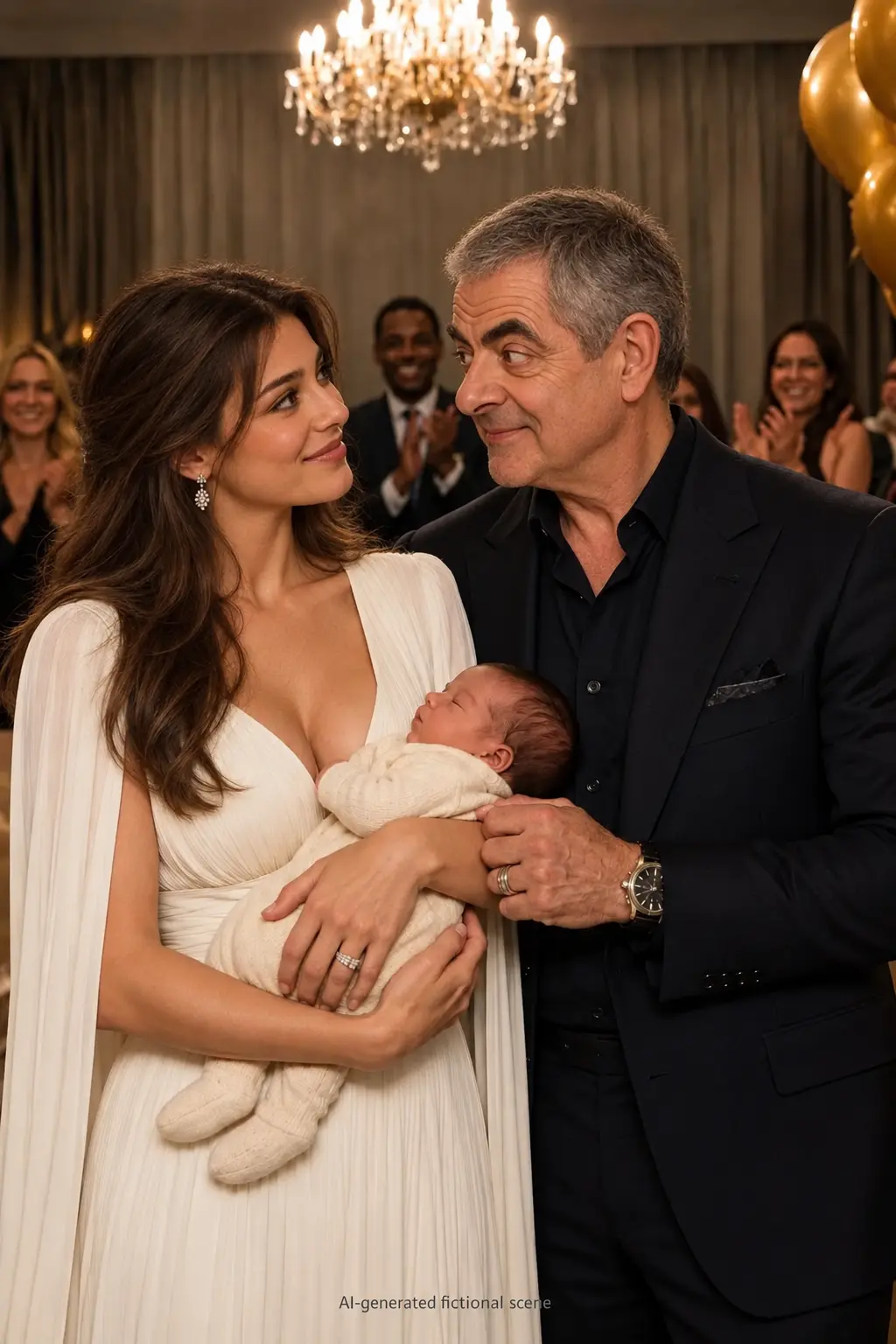
He spoke, in this fictional dialogue, about how a newborn changes the pace of a room. Adults who usually rush become careful. Voices become softer. People notice whether a blanket is warm enough or a light is too bright.
“You find yourself paying attention,” he said.
He paused to look down.
“And that seems a very good place to begin.”
There was no sweeping declaration. The words stayed close to what everyone could see.
A child needed support, warmth, and care. For those few minutes, providing those things had become the most important task in the room.
Lily listened with her hands folded in her lap.
The scene offered her no dramatic revelation about her father. Its tenderness came from seeing something familiar made visible to others: the attention that can exist behind a reserved manner, expressed through practical actions rather than an emotional speech.
When Rowan finished speaking, he did not immediately stand.
The baby had curled a hand around the edge of his jacket.
He looked toward the parents again, lifting his eyebrows slightly.
The mother approached, smiling, and gently loosened the tiny fingers.
That small interruption became the evening’s most charming detail. A carefully arranged ceremony had briefly yielded to an infant’s grip, and everyone seemed delighted to accept the change.
Rowan rose slowly and returned the newborn to the mother’s arms.
For a moment, he kept one hand beneath the blanket until she had a secure hold. Then he stepped back.
Applause began softly.
The host allowed it to continue without introducing another speaker. The parents stood together, looking down at their child, while Rowan moved away from the brightest part of the stage.
He searched the audience once more.
Lily was already standing.
Their eyes met, and she gave him a small nod.
It was an understated acknowledgment, almost lost amid the applause. Yet it carried the warmth of a private conversation.
Later, during the reception imagined for this story, the hall filled with the ordinary sounds of a gathering finding its rhythm again. Cups touched saucers. Someone asked the musicians about a piece they had played. Guests moved aside to make room for the baby’s parents.
Rowan stood near a table when Lily approached.
She touched his arm before speaking.
“You looked very comfortable up there,” she said.
He glanced toward the mother holding the infant.
“I was receiving excellent supervision.”
Lily laughed and embraced him.
The exchange was brief. Neither tried to explain the emotion of the earlier scene. They stood together for a while, speaking quietly as the reception continued around them.
That restraint gives this imagined evening its lasting appeal.
There is room for affection without a public confession, and for emotion without a detailed explanation. Lily can be moved by watching her father. Rowan can respond through a small joke and a returned embrace.
Across the room, the newborn sleeps through it all.
By the end of the night, the flowers are being gathered and the musicians are closing their cases. Guests retrieve coats, exchange goodbyes, and lower their voices as they pass the sleeping child.
Rowan and Lily pause near the exit to thank the parents.
Then they leave together, carrying no grand announcement from the evening—only the memory of a small hand, a softly lit stage, and a few minutes when everyone had slowed down enough to pay attention.