💖 “I’d Choose You Again”: Sylvester Stallone and Jennifer Flavin’s Dream Vow Renewal Makes a Beautiful Hollywood Love Story
The doors open slowly, and for a moment, even the music seems to fade into the background.
Jennifer Flavin stands beneath an arch of ivory roses, her gown catching the soft light from hundreds of candles. At the end of the aisle, Sylvester Stallone watches with an expression that needs no dramatic introduction.
In this imagined Hollywood celebration, the occasion is a renewal of vows: an opportunity to stand together again, acknowledge the years behind them, and make a deliberate promise about the years ahead.
There are flowers, elegant evening clothes, and a room designed to take the breath away. Yet the emotional center of the scene is much smaller.
It is the moment Jennifer reaches Sylvester, and he quietly says, “Look at you.”
She smiles.
“Look at us.”
Their exchange, like the ceremony itself, belongs to this fictional story. But it establishes the mood for an evening built around affection, humor, and the complicated beauty of choosing a shared life.
The imagined setting is a private garden estate, where white flowers climb stone columns and long tables stretch beneath strings of golden lights. Beyond the terrace, trees move gently in the evening breeze.
The decoration is lavish without overwhelming the gathering. Crystal glasses reflect the candlelight. Cream-colored menus rest beside handwritten place cards. A small ensemble plays near the entrance, allowing conversation to drift through the garden.
Guests arrive expecting an elegant party. What they encounter is something more intimate: a celebration designed around the couple’s own memories.
Near the reception area stands a table of photographs. In this fictional arrangement, formal portraits sit beside ordinary snapshots, their imperfect framing giving them a warmth that polished images cannot reproduce.
The display invites people to pause.
A relationship can look effortless in a single photograph. A collection of pictures tells another story—one involving different seasons, changing expressions, and the gradual accumulation of a life together.
Jennifer’s imagined gown follows the same understated approach.
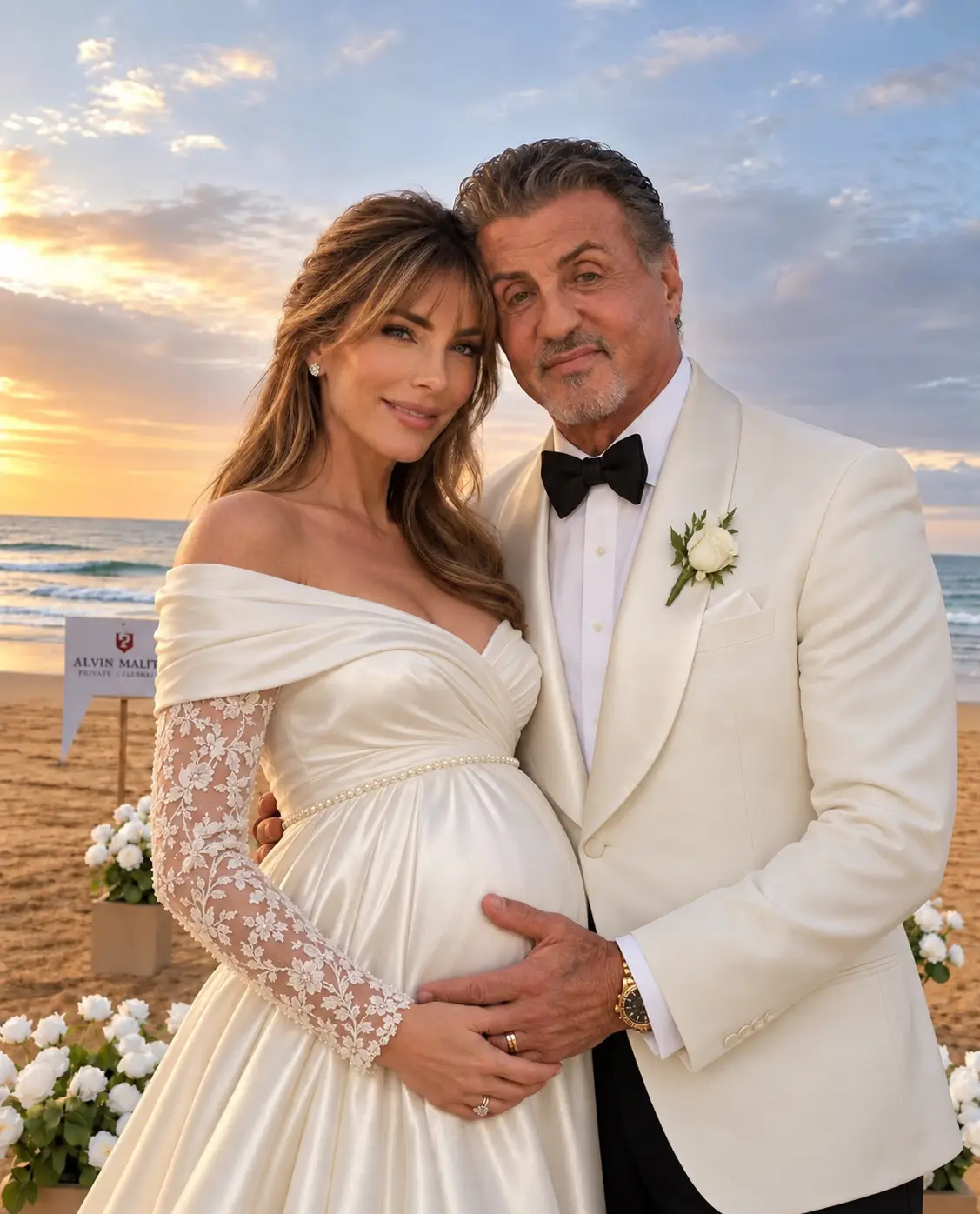
Made from ivory silk, it features a softly structured neckline, long sleeves, and a flowing skirt. A short train moves behind her as she walks, while a delicate veil frames her face.
Her jewelry is minimal. The emphasis rests on her expression: composed at first, then visibly emotional when she sees Sylvester waiting.
He wears a midnight-blue tuxedo with a white rose at the lapel. Before the ceremony begins, he adjusts his cuffs more than once.
Someone nearby makes a gentle joke about his nerves.
Sylvester laughs, then looks toward the entrance again.
In a scene filled with expensive details, that small gesture becomes one of the most revealing. The character at the center of this imagined ceremony is a husband waiting for his wife, suddenly conscious of how much he wants to say well.
When Jennifer arrives beside him, he offers his hand immediately.
The officiant welcomes the gathering and explains the purpose of the evening. A renewal of vows, in this fictional ceremony, is an occasion to recognize that promises acquire meaning through the years spent trying to keep them.
The words allow room for an honest celebration.
Nobody needs to pretend that a long relationship unfolds without misunderstanding, disappointment, or change. The beauty of the occasion comes from acknowledging that love requires attention even after the photographs have been taken and the guests have gone home.
Jennifer listens with her eyes lowered briefly, then looks back at Sylvester.
He squeezes her hand.
When it is his turn to speak, he unfolds a small piece of paper.
“I wrote this down,” he begins, “because I know what happens when I decide I can improvise.”
Laughter moves through the guests, breaking the tension.
Then his voice softens.
“When you build a life with someone, you begin to understand how much of it happens in little moments. The conversations nobody hears. The kindness nobody photographs. The patience you don’t always remember to thank them for.”
He pauses and glances at the page.
“Tonight, I want to remember.”
Within the fictional scene, his vows remain simple. He promises to listen more carefully, express gratitude more often, and make time for the everyday companionship that can be overlooked when life becomes crowded.
Jennifer blinks away tears.
There is no grand declaration about perfection. His words focus on the practical tenderness of being present.
When she begins her own vows, she starts with a smile.
“I had a very elegant speech prepared,” she says. “Then you made me cry.”
Another ripple of laughter passes through the garden.
She gathers herself.
“What I want to celebrate is the life we keep making. The small routines. The unexpected laughter. The way a familiar person can still surprise you.”
Her imagined promise is equally direct: to keep speaking honestly, to protect their time together, and to remain curious about the person standing beside her.
“I want us to keep discovering things,” she says. “Even here. Even now.”
That line gives the ceremony its quiet sense of possibility.
A long history does not mean there is nothing left to learn. Familiarity can offer security while leaving room for growth, new interests, and different ways of showing affection.
The rings are brought forward on a small velvet cushion.
Sylvester takes Jennifer’s hand, briefly struggling to steady his own.
For all the careful planning around them, the moment becomes charmingly imperfect. Jennifer laughs through her tears, and he smiles in response.
Then he delivers the line that defines this imagined evening.
“I’d choose you again.”
She answers without hesitation.
“And I’d choose you.”
Applause rises as they embrace. The musicians begin to play, but for several seconds the couple remain close, exchanging words too quiet for anyone else to hear.
The reception opens beneath the lights of the terrace.
Dinner is served at long tables decorated with white roses, greenery, and low candles. The atmosphere gradually shifts from ceremony to celebration. Conversations grow louder, jackets loosen, and laughter carries across the garden.
In this fictional gathering, the guest list includes friends from creative and professional circles, but no real celebrity attendance is claimed.
The evening belongs most clearly to the people who know the couple through ordinary experiences: shared meals, personal conversations, and years of showing up.
During the toasts, one speaker offers a thought that earns an appreciative response.
“The best part of tonight is that tomorrow can be a normal day—and this will still matter.”
Jennifer nods.
It is a fitting observation for a ceremony whose meaning depends on what follows it.
Later, the couple step onto the dance floor.
Their first dance is unhurried. Sylvester says something that makes Jennifer tilt her head back with laughter. For a few seconds, the carefully arranged beauty of the reception gives way to an entirely spontaneous moment.
That is the image this fictional feature leaves behind: two people laughing together beneath the lights, surrounded by a celebration that will soon end.
The flowers will be cleared. The candles will burn down. The music will stop.
The promises will accompany them into the next morning, where their real significance begins—in attention, patience, gratitude, and another ordinary day spent choosing each other.