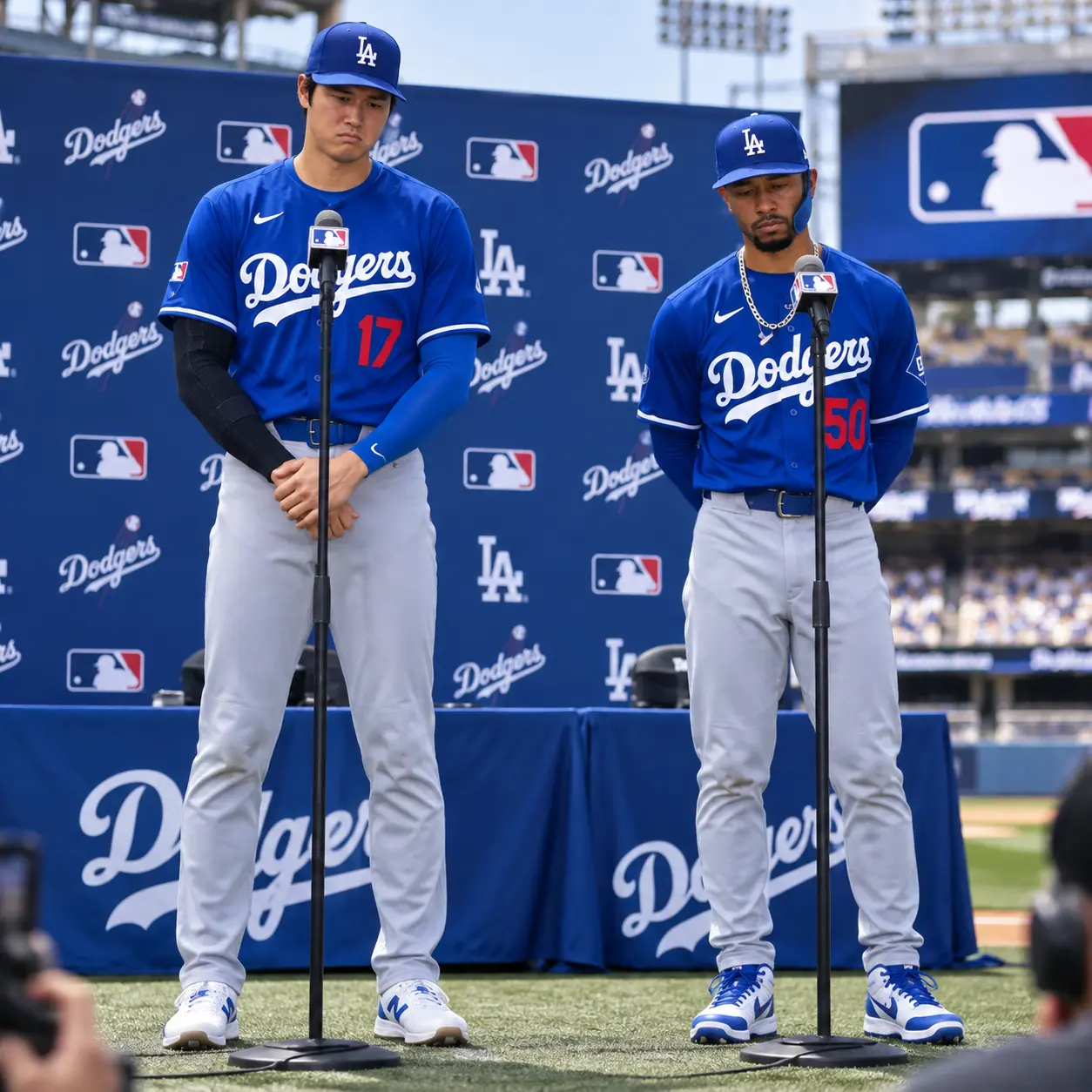
The Los Angeles Dodgers are accustomed to pressure, enormous expectations and the constant attention that comes with having one of baseball’s most star-studded rosters.
But nobody was prepared for a scene like this.
In a fictionalized, dramatic scenario that would immediately send shockwaves through the MLB world, tensions between Mookie Betts and Shohei Ohtani suddenly boiled over, ending with Ohtani on the ground and stunned teammates rushing toward the two Dodgers superstars.
Then came the moment nobody expected.
Ohtani got back to his feet, looked directly at Betts and delivered only five words:
“We’re supposed to be teammates.”
No shouting.
No retaliation.
No attempt to escalate the confrontation.
Just five words — and suddenly the entire atmosphere changed.
TENSION EXPLODES WITHOUT WARNING
The scene began like countless competitive moments inside a professional baseball environment.
Players were frustrated. Emotions were elevated. Expectations surrounding Los Angeles were enormous, and neither Betts nor Ohtani appeared willing to back away from the disagreement.
At first, teammates reportedly viewed it as nothing more than an intense exchange between two elite competitors.
Then everything changed.
The argument became increasingly heated. Voices rose. The distance between the two players disappeared.
And suddenly Ohtani went down.
For a brief moment, everything seemed to freeze.
Several Dodgers players immediately moved toward the confrontation, attempting to separate the two stars before the situation could become even more serious.
Betts stood nearby, visibly emotional.
Ohtani remained down momentarily before getting back onto his feet.
Everyone seemed to expect an explosive reaction.
They didn't get one.
OHTANI RESPONDS WITH FIVE WORDS
Ohtani looked toward Betts.
The room went quiet.
Then came the five words:
“We’re supposed to be teammates.”
The response carried considerably more weight than an angry comeback might have.
Ohtani wasn't challenging Betts to continue.
He wasn't insulting him.
Instead, he reminded him of something much bigger than the argument itself.
They wore the same uniform.
They shared the same clubhouse.
They were chasing the same goal.
And regardless of whatever had caused the confrontation, they were supposed to be fighting together — not against each other.
For those standing nearby, that realization changed the entire tone of the scene.

BETTS FALLS SILENT
Perhaps the most dramatic element was what happened next.
Betts reportedly did not immediately respond.
The intensity that had surrounded the confrontation only seconds earlier disappeared.
No second push followed.
No additional shouting.
Instead, there was silence.
In this imagined scenario, teammates eventually guided the two stars in opposite directions, giving both an opportunity to cool down.
But Ohtani's five-word message remained impossible to ignore.
“We’re supposed to be teammates.”
For a Dodgers roster built with championship expectations, those words would cut directly to the heart of what matters.
WHY THIS WOULD BE A MASSIVE DODGERS STORY
A confrontation involving any two teammates would attract attention.
A confrontation involving Ohtani and Betts would be something entirely different.
They aren't ordinary MLB players.
Ohtani has become one of the defining baseball stars of his generation, with his extraordinary combination of power, athleticism and international popularity making him one of the sport's biggest attractions.
Betts has likewise established himself as one of baseball's most recognizable and accomplished players, bringing elite ability, experience and a competitive personality to Los Angeles.
Together, they represent a massive part of the Dodgers' championship ambitions.
That's why even the appearance of serious friction between them would immediately raise questions.
Was this simply an isolated emotional moment?
Had frustration been building behind closed doors?
Could they quickly move past it?
Or would the confrontation leave lingering tension inside the clubhouse?
Those would become the questions surrounding Los Angeles.
ONE MOMENT DOESN'T HAVE TO DEFINE A TEAM
Professional sports are intensely emotional.
Teammates argue.
Competitors become frustrated.
Players who spend nearly every day together over the course of a long season inevitably disagree.
The important question is often not whether conflict happens.
It's what happens afterward.
That is where Ohtani's hypothetical five-word response becomes so significant.
Rather than turning the confrontation into something even uglier, the message creates an opportunity for perspective.
Championship teams don't necessarily exist without disagreement.
They survive disagreement by refusing to allow it to become bigger than their shared objective.
For Betts and Ohtani, that objective would remain obvious: helping Los Angeles win.
WHAT HAPPENS NEXT?
There would still be questions that needed answering.
Would Betts apologize?
Would Ohtani accept?
Would the two address the incident together?
And perhaps most importantly, what would happen when they returned to the field side by side?
Sometimes reconciliation isn't demonstrated through a press conference.
Sometimes it's a handshake in the dugout.
A conversation away from cameras.
A teammate celebrating another teammate's home run.
A reminder that whatever happened before is staying in the past.
For two players carrying enormous expectations, the next interaction could say more than any carefully prepared statement.
Because in this fictional Dodgers shocker, Ohtani didn't need a long speech.
He needed only five words.
“We’re supposed to be teammates.”
And suddenly, what began as an explosive confrontation became something entirely different — a test of whether two of baseball's biggest stars could put emotion aside, repair the damage and remember exactly what they were trying to accomplish together.