🚨 “MORE THAN 270 NAMES…” — MASSACHUSETTS REPORT IDENTIFIES CATHOLIC CLERGY LINKED TO DECADES OF CHILD SE.XUAL ABUSE ALLEGATIONS
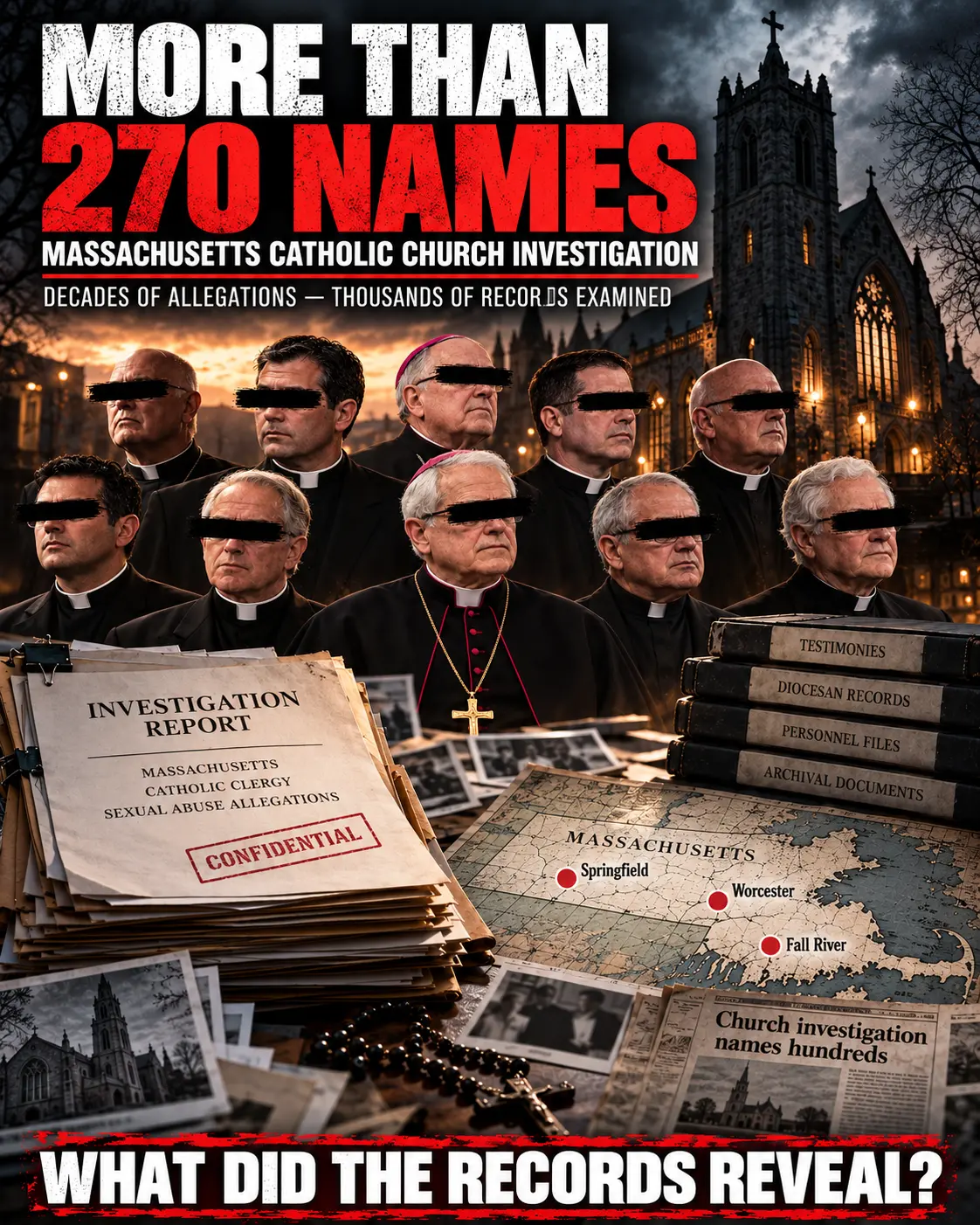
A sweeping Massachusetts investigation has brought renewed attention to one of the darkest chapters in the state’s Catholic Church history, identifying more than 270 clergy members connected to allegations involving hundreds of children across the Fall River, Springfield and Worcester dioceses.
Behind the staggering numbers are decades of complaints, internal records and painful accounts that raise an even larger question: How were so many allegations able to accumulate over such a long period — and what did Church officials know as the cases unfolded?
The newly released findings are now putting old personnel files, transfers and decisions made behind closed doors back under scrutiny.
And buried within those records may be the detail that matters most: when did Church leadership first learn that children could be at risk?
👇 THE MASSACHUSETTS INVESTIGATION — AND WHAT THE RECORDS REVEAL — IN THE FIRST COMMENT.
The scale of the findings released by Massachusetts Attorney General Andrea Joy Campbell on September 30, 2026, is difficult to absorb.
The Attorney General’s Office says its investigation found evidence that more than 270 Catholic clerics abused nearly 1,000 children over roughly a century in the dioceses of Fall River, Springfield and Worcester. The official report identifies 944 children in connection with the abuse examined by investigators.
But investigators were looking at more than individual accusations.
Beginning in 2019, teams of attorneys, investigators, police personnel and victim-witness advocates examined how the three dioceses responded when allegations surfaced, whether Church officials followed their own procedures and whether children were adequately protected.
The scale of that work was enormous.
According to the Attorney General’s Office, investigators reviewed more than 300,000 pages of records and interviewed more than 100 people, including survivors, advocates, attorneys, clergy members, diocesan employees and experts in canon law and child se.xual abuse.
What emerged was a disturbing institutional history.
The report says diocesan leaders sometimes failed to respond adequately to allegations and warning signs. Investigators documented instances in which accused or offending priests were transferred to other parishes without the reasons being disclosed, priests were returned to ministry following treatment without adequate supervision, restrictions were not meaningfully enforced and the reasons for removing priests from ministry were concealed.
The report also found failures to consistently report allegations to law enforcement.
That finding is crucial because it changes the central question.
The story is not simply about what individual clergy members allegedly or demonstrably did. It is also about what happened after Church officials received information suggesting that abuse had occurred or that a child could be at risk.
Who received the complaint?
What action followed?
Was law enforcement contacted?
Was the accused person removed from contact with children?
And if a priest was moved somewhere else, what was the receiving parish told?
Those questions recur throughout the history reconstructed by investigators.
For survivors, however, the statistics represent something far more personal than an institutional timeline.

Behind every entry in a personnel record was a child. Behind every complaint was a person who might carry the consequences for decades. Campbell emphasized that many survivors lived with those consequences for years, while some people whose experiences contributed to the historical picture are no longer alive.
The investigation also forces Massachusetts to confront an uncomfortable legal reality.
Despite the magnitude of the findings, the investigation itself produced no new indictments.
That does not mean investigators concluded that nothing illegal happened.
The Attorney General’s Office explained that some conduct occurred so long ago that applicable statutes of limitations had expired. Other conduct occurred before Massachusetts enacted stronger child-protection laws in 2002 and therefore could not be prosecuted retroactively under statutes that did not exist when the conduct occurred.
Many individuals identified in the report are also deceased.
Three cases were referred to district attorneys during the investigation, according to the state, and one referral to the Worcester County District Attorney’s Office resulted in criminal charges in District Court.
That distinction — between what historical evidence can establish and what prosecutors can legally charge today — is one of the most consequential aspects of the report.
It also explains why the Attorney General is now calling for changes to Massachusetts law.
Among the proposals are eliminating the statute of limitations for civil claims involving childhood se.xual abuse, removing the state’s $20,000 charitable-immunity cap for such claims and establishing an indefinite “lookback” period that could allow some survivors whose claims have expired to pursue civil remedies.
The investigation arrives against the backdrop of another defining moment in Massachusetts history.
In 2002, reporting on se.xual abuse and institutional failures within the Archdiocese of Boston helped trigger an international reckoning over clergy abuse. The new Massachusetts report is significant because state officials describe it as the first comparable public accounting of what occurred in the Fall River, Springfield and Worcester dioceses.
The Catholic Church has changed many of its procedures since the 2002 crisis became public.
The three dioceses established child-protection and victim-assistance offices, expanded background checks and safe-environment training, strengthened review procedures and adopted new systems for reporting and investigating allegations.
The Massachusetts investigation acknowledges those reforms.
But it also concludes that having policies on paper is not enough.
Investigators found that policies were not always consistently followed and that exceptions sometimes weakened safeguards designed to protect children. The Attorney General consequently called for stronger oversight, more consistent investigations, meaningful enforcement of restrictions and greater transparency surrounding credibly accused clergy.
One particularly notable transparency issue remains unresolved.
According to the Attorney General’s Office, the Diocese of Worcester is the only Catholic diocese in Massachusetts that does not maintain a publicly accessible list of credibly accused clergy, a practice adopted by the state's other dioceses.
For the public, that detail brings the story back to the names.
More than 270 clergy members.
Nearly 1,000 children.
Hundreds of thousands of pages examined.
More than 100 interviews.

And decades of institutional decisions that investigators have now attempted to reconstruct.
But the most consequential legacy of the investigation may not be the size of those numbers.
It may be the paper trail behind them.
A complaint received. A warning documented. A transfer approved. A restriction imposed — or not imposed. A report made to police — or never made.
Taken individually, those decisions might appear bureaucratic. Viewed across decades, the Attorney General says they reveal systemic failures that allowed abuse, in some instances, to continue for years.
That is why the Massachusetts report is not simply another list of historic allegations.
It is an examination of what institutions did when warning signs appeared — and whether protecting children was consistently placed ahead of protecting the institution itself.
More than two decades after the Boston clergy-abuse scandal forced Massachusetts and the Catholic Church into a historic reckoning, the newly released records show that another chapter is still being confronted.
And for hundreds of survivors and their families, the most important question is no longer simply how many names appear in the report.
It is what happens now that those records are finally in public view.