QUESTIONS ERUPT AFTER ACES ELIMINATE FEVER 94–83 — WHAT WE ACTUALLY KNOW ABOUT THE POSTGAME RUMOR
LAS VEGAS — What should have been a straightforward celebration of another Las Vegas Aces playoff advancement has become surrounded by an entirely separate online controversy.
The defending champions defeated the Indiana Fever 94–83 on October 1 in the deciding Game 3 of their first-round WNBA playoff series, winning the series 2–1 and officially advancing to the semifinals. The result is reflected in the WNBA's official game recap and the Aces' own postseason coverage.
But within hours of the final buzzer, posts began circulating online alleging something much more serious: that two unidentified Las Vegas players had supposedly undergone additional postgame medical scrutiny connected to a prohibited substance.
At this point, that claim remains unverified.
No credible WNBA announcement located as of October 3 says two Aces players failed drug tests, tested positive for a banned substance, were suspended, or caused the Game 3 result to be placed under review.
That distinction is crucial.
What is confirmed is what happened on the basketball court.
A’ja Wilson delivered another enormous postseason performance, finishing Game 3 with 36 points and 10 rebounds. Chelsea Gray scored 23 points, while Jackie Young added 18 points, eight rebounds and seven assists. Jewell Loyd, inserted into the starting lineup with Stephanie Talbot unavailable because of a leg injury, contributed 11 points.
Indiana refused to disappear quietly.
Caitlin Clark erupted for 11 points in the first quarter before Las Vegas increasingly limited her opportunities. She eventually finished with 18 points. Kelsey Mitchell led Indiana with 23, while Aliyah Boston produced 19 points and 10 rebounds.
The game itself was intensely physical.
Clark and Aces forward Brianna Turner received technical fouls a little more than three minutes into the contest after Turner entered an Indiana huddle and Clark pushed her away.
Indiana coach Stephanie White later received a technical foul while protesting another sequence involving Turner and Lexie Hull.
The tension only increased from there.
Indiana twice reduced Las Vegas' advantage to two points during the fourth quarter, threatening to complete a comeback before the Aces finally pulled away.
Then came perhaps the night's most controversial sequence.
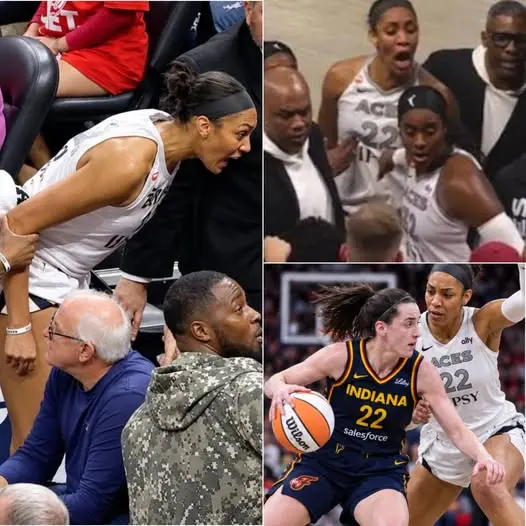
Clark was struck in the mouth by an elbow while battling for a rebound late in the game. She was visibly bleeding, briefly left the floor and eventually returned. No foul was assessed on the play.
That incident generated its own wave of criticism about officiating.
It also arrived after a series already filled with confrontation.
During Game 2, Wilson became involved in a heated exchange with a courtside spectator after an incident involving Sophie Cunningham. Wilson received a technical foul, but the league subsequently determined she would not receive an additional suspension for Game 3. Reuters reported that Kalani Brown and Kierstan Bell also avoided discipline for leaving the bench area during the episode.
Against that emotionally charged background, it is easy to understand why another dramatic allegation could spread quickly.
Understanding why it spreads, however, is very different from establishing that it is true.
The online substance allegation currently has several major evidentiary gaps.
There is no publicly verified identification of the supposed two players.
There is no confirmed positive test.
There is no publicly documented disciplinary notice establishing that a prohibited-substance violation occurred.
And there is no official announcement saying Las Vegas' 94–83 victory is being reconsidered.
Those omissions matter because an allegation involving performance-enhancing or otherwise prohibited substances can seriously damage an athlete's reputation.
Until reliable documentation emerges, attaching the allegation to specific Aces players would go beyond the available evidence.
The legitimate question fans can ask is narrower: What would happen if an actual violation were eventually confirmed?
That answer would depend heavily on the facts.
Professional sports disciplinary systems distinguish among substances, testing circumstances, medical exemptions, procedural questions and the rules applicable to a particular violation. A confirmed individual violation therefore would not automatically establish that an entire team's victory should be erased.
Nor would the existence of testing itself demonstrate wrongdoing.
Testing and medical procedures are not synonymous with a positive result.
The WNBA would need to determine whether a violation occurred and then apply the relevant rules and procedures before any punishment could be established.
That is why the most dramatic version circulating online — that Indiana might suddenly be restored to the playoffs — should not be presented as an established possibility arising from the current evidence.
As things officially stand, Las Vegas won Game 3.
Las Vegas won the series 2–1.
Indiana's season ended.
And the Aces advanced to the WNBA semifinals.
For Fever supporters, the controversy nevertheless lands at an especially emotional moment.
Indiana entered the postseason hoping to make a deeper run around Clark and an increasingly experienced supporting cast. Instead, the Fever once again watched Las Vegas end their season.
Clark's final appearance made the ending even more dramatic.
After starting aggressively, she struggled to generate the same offensive production over the final three quarters. Then, with Indiana desperately attempting to extend its season, she suffered the bloody-mouth incident that became one of the defining images of Game 3.
Wilson, meanwhile, answered the pressure surrounding Las Vegas with one of the night's dominant performances.
Her 36-point effort followed a 38-point, 16-rebound performance in Game 1, reinforcing just how influential she was throughout the series.
None of those verified basketball facts establishes anything about the prohibited-substance rumor.
That separation should remain clear.
Social media often compresses three very different things — a claim, an investigation and a confirmed violation — into one dramatic headline. They are not interchangeable.
A claim is simply an allegation.
An investigation, if one were officially announced, would mean authorities were examining evidence.
A confirmed violation would require an actual determination under the applicable rules.
At present, the explosive online story has not reached that final threshold based on credible information publicly available.
Until something changes, Las Vegas remains the legitimate winner recorded by the WNBA, and Indiana remains eliminated.
But the rumor has created one legitimate reason to keep watching: if the WNBA or another authoritative party releases information concerning the allegation, the facts could be evaluated against the speculation already circulating.
Until then, fans should treat the alleged postgame substance issue as exactly what it currently is:
an unverified rumor — not a confirmed scandal.
DISCLAIMER: This article discusses an unverified online allegation for news-analysis purposes. As of October 3, 2026, no credible WNBA announcement located for this report confirms that two Las Vegas Aces players tested positive for a prohibited substance, received related suspensions, or that the Aces' 94–83 Game 3 victory over the Indiana Fever is under review. No individual player should be assumed to have committed a violation without verified evidence or an official finding.