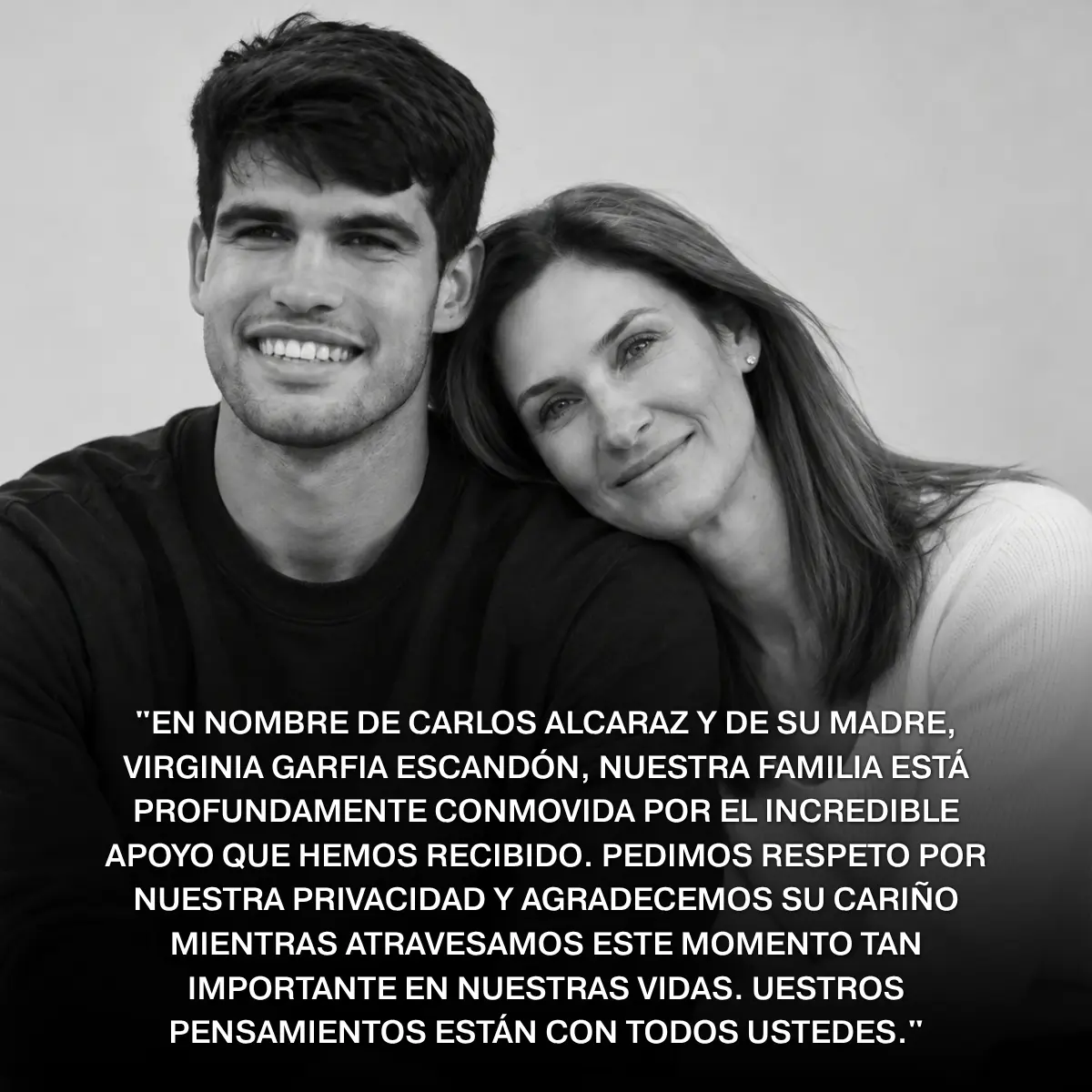
💔🎾 TENNIS WORLD MOVED BY VIRGINIA GARFIA ESCANDÓN’S REFLECTION ON CARLOS ALCARAZ — THE FAMILY BOND BEHIND A CHAMPION’S SUCCESS
MURCIA, SPAIN — Behind every extraordinary tennis champion is a story that extends far beyond the trophies, the packed stadiums, and the roar of the crowd. For Carlos Alcaraz, one of the most important parts of that story is his family—and particularly his mother, Virginia Garfia Escandón.
A renewed wave of interest in Virginia’s reflections about her son has drawn attention to the emotional side of Alcaraz’s remarkable journey. While the Spanish superstar is celebrated around the world for his talent, competitive spirit, and determination, his family sees another side of him: the son who grew up in El Palmar, the young man who still values home, and the person whose happiness matters far more than any individual victory.
Virginia has previously spoken about the pressure surrounding her son’s career, the expectations placed on a young athlete, and her desire to protect him from the demands of international fame. Her words offer a meaningful perspective on a question that follows many elite competitors: how can someone pursue greatness without losing the ordinary life that makes success worthwhile?
Although the latest online headline does not provide a new, verified quotation from Virginia, her previously reported comments offer a genuine basis for exploring the family bond that has helped shape Alcaraz’s life.
A MOTHER WHO HAS WATCHED HER SON’S WORLD CHANGE
Carlos Alcaraz’s rise has been extraordinary. Born in El Palmar, near Murcia, Spain, in 2003, he began playing tennis as a young child and quickly developed the qualities that would eventually distinguish him on the professional circuit.
His father, Carlos Alcaraz González, played an important role in introducing him to the sport. His mother, Virginia, supported the family as Carlos progressed from a promising youngster to an international star.
The journey demanded commitment from the entire family. Tennis requires extensive training, travel, financial planning, and sacrifices that can affect everyday life long before a player reaches the biggest tournaments.
For parents, watching a child pursue an ambitious dream can bring pride and anxiety in equal measure. Every breakthrough offers excitement, but every setback can be difficult to witness when so much effort has gone into reaching that moment.
Today, Alcaraz competes before enormous audiences and faces expectations that would challenge even experienced professionals. Yet the family connection remains an important part of his identity.
The ATP Tour’s official player biography identifies Virginia as his mother and lists his father and three brothers among his immediate family. The same biography records how Alcaraz began playing tennis at just four years old. <Cite refs={["turn188929search0"]}/>
His achievements may have transformed his public profile, but the people who knew him before the trophies remain an important connection to his roots.
THE PRESSURE OF BECOMING A TENNIS LEGEND
Success in professional tennis brings more than competition. It brings comparisons, predictions, criticism, and the constant expectation that a champion must continue delivering extraordinary performances.
Alcaraz has frequently been compared with Rafael Nadal, the Spanish icon whose achievements helped define an era of men's tennis. Such comparisons are understandable: fans naturally look for the next great champion when a new talent begins collecting major titles.
But expectations can become burdensome when a young athlete is measured against the achievements of another player.
In the Netflix documentary Carlos Alcaraz: My Way, Virginia expressed concern about the expectations surrounding her son and the possibility of excessive pressure damaging his well-being.
As reported by Spanish and international media, she warned that people expected Carlos to become a legend like Nadal, while emphasizing that she did not want him to be pushed to the point of becoming emotionally worn down by those expectations. <Cite refs={["turn188929search3","turn188929search5"]}/>
The message behind her concern is powerful. Wanting a child to succeed is not the same as wanting that child to sacrifice everything for success.
Virginia’s perspective reflects a parent's instinct to protect the person behind the public image. Alcaraz can pursue championships, work toward historic achievements, and challenge the best players in the world without being required to define his entire worth through tennis.
WHY FAMILY SUPPORT MATTERS MORE THAN TROPHIES
For professional athletes, the difference between winning and losing can sometimes be a handful of points. Their careers are measured through rankings, statistics, titles, and records.
But family relationships operate by a different standard.
A parent does not need a championship trophy to feel proud of a child. A difficult loss does not erase years of effort, and a disappointing tournament does not change the importance of the person returning home afterward.
This distinction can provide an athlete with emotional stability. Knowing that family members care about more than results can help create a sense of perspective when the pressure becomes overwhelming.
Alcaraz has repeatedly shown appreciation for his family, including his mother. One memorable example came at the Madrid Open in 2023, when he dedicated his victory to Virginia around Mother's Day in Spain.
According to Tennis.com, Alcaraz wrote “Por ti, mamá”—meaning “For you, Mom”—on a camera lens after winning the title. He later explained that seeing his mother supporting him in person made the victory especially meaningful. <Cite refs={["turn188929search2"]}/>
It was a small gesture in the middle of a major sporting achievement, but it communicated something important: for all the attention surrounding his success, his mother's presence still mattered deeply to him.
THE EMOTIONAL SIDE OF A CHAMPION
Professional tennis often celebrates toughness. Players are expected to remain composed under pressure, recover quickly after defeat, and return to competition with confidence.
Yet resilience does not mean being unaffected by challenges.
Athletes experience fatigue, disappointment, uncertainty, and the demands of maintaining a public image. They also face constant scrutiny from spectators and commentators who may judge a performance without understanding the personal circumstances surrounding it.
Alcaraz's mother has spoken about the importance of protecting his personal space and allowing him to live as a young man rather than treating him solely as a sporting phenomenon.
That concern is particularly relevant in an era when social media can amplify every mistake and turn ordinary moments into public debates.
A champion may be admired by millions while still needing time to rest, spend time with loved ones, and enjoy life outside competition.
Family can help maintain that balance by reminding an athlete that identity is larger than professional achievement.
For Virginia, the priority is not simply whether her son wins another trophy. It is whether he can continue pursuing his ambitions while remaining happy, grounded, and connected to the people who love him.
A FAMILY THAT KNEW CARLOS BEFORE THE WORLD DID
The global audience sees Alcaraz at his most visible: celebrating match points, lifting trophies, delivering interviews, and competing against the world's best.
His family knows the years of work behind those moments.
They remember the young player who first stepped onto a tennis court, the hours of practice, the difficult decisions, and the gradual transformation of a promising talent into a Grand Slam champion.
That history gives family members a different perspective on success. They understand that the final score represents only one small part of a much longer journey.
A victory may last for a day in the headlines, but the experiences that shaped the player continue to matter long afterward.
This is why Virginia’s reflections have resonated with readers. They shift attention away from rankings and records and toward the human relationships that help athletes navigate extraordinary lives.
Her perspective also offers a reminder to fans: admiration should leave room for compassion. Athletes can be celebrated for their accomplishments without being expected to perform perfectly at every moment.
RESILIENCE MEANS MORE THAN BOUNCING BACK ON COURT
Resilience is often described as the ability to recover after a defeat. In sport, that can mean learning from a difficult match, adjusting tactics, and preparing for the next challenge.
But resilience also involves knowing when to rest, recognizing personal limits, and accepting that setbacks are part of life.
For a young champion facing intense expectations, that broader understanding can be essential.
Alcaraz has expressed a desire to pursue greatness in his own way, rather than simply copying the path of earlier legends. His family's support can help him maintain that independence while continuing to develop as a competitor.
Virginia's concern about pressure does not suggest that her son should abandon ambition. Instead, it highlights the importance of ensuring that ambition remains compatible with a healthy, fulfilling life.
That balance is not always easy to achieve. Professional sport demands discipline, sacrifice, and consistency. Yet a career can be more sustainable when success is supported by strong personal relationships and a clear sense of identity.
THE MESSAGE BEHIND VIRGINIA GARFIA ESCANDÓN’S WORDS
The renewed interest in Virginia's reflections highlights a truth that applies far beyond tennis: behind public achievement is a person whose needs cannot be measured entirely through professional results.
Alcaraz's career has already brought him extraordinary accomplishments, but his story is still unfolding. There will be more tournaments, more victories, and inevitably more difficult moments.
Through all of them, family can offer something that rankings and trophies cannot—a place where he is valued as a person rather than evaluated as a player.
Virginia's previously reported comments about pressure and protecting her son from unrealistic expectations offer a meaningful reminder that success should not come at the expense of well-being. <Cite refs={["turn188929search3","turn188929search5"]}/>
The original viral post does not establish that she has made a new statement in response to a specific recent event. Nevertheless, her documented reflections already provide a compelling window into the concerns of a mother watching her son navigate worldwide fame.
BEYOND TENNIS, THE FAMILY BOND REMAINS
Carlos Alcaraz's journey is often described through records, championships, and the promise of further greatness. Those achievements deserve recognition.
But the family story is equally important because it reminds the world what statistics cannot show: the years of encouragement, the sacrifices made away from cameras, and the emotional support that continues when a match is over.
Virginia Garfia Escandón's perspective is a reminder that even the most celebrated athletes need room to grow, make mistakes, rest, and enjoy life beyond their profession.
The greatest measure of a champion is not only what he wins on court, but also whether he can continue pursuing his dreams without losing the happiness, relationships, and sense of self that make those dreams meaningful.
For Carlos Alcaraz, the love and support of his family remain an important part of that journey—and a powerful reminder that behind every champion is a human story worth understanding.